
Hydrogen sulfide is a toxic and corrosive substance, as well as a well-known poison for industrial catalysts.
The appropriate desulfurization method depends on several factors, including the sulfur content, desired output sulfur levels, specific sulfur compounds to be removed, and the composition and pressure of the sulfur-containing gas stream.
Currently, the removal of hydrogen sulfide using zinc oxide adsorbents is the most common method. This adsorbent, known as a desulfurization catalyst, is a mixture of ZnO and aluminum oxide, along with certain additives. Zinc oxide is highly effective for hydrogen sulfide removal, has a high sulfur absorption capacity, and is neutral to water vapor.
One type of desulfurization adsorbent is the promoted adsorbent. Promoted desulfurization adsorbents are used to remove sulfur compounds from gas streams. These adsorbents are enhanced with specific materials (promoters, typically copper nanoparticles) to achieve higher efficiency and absorption capacity. This improvement may include increased absorption speed, higher capacity, or enhanced selectivity for specific sulfur compounds.
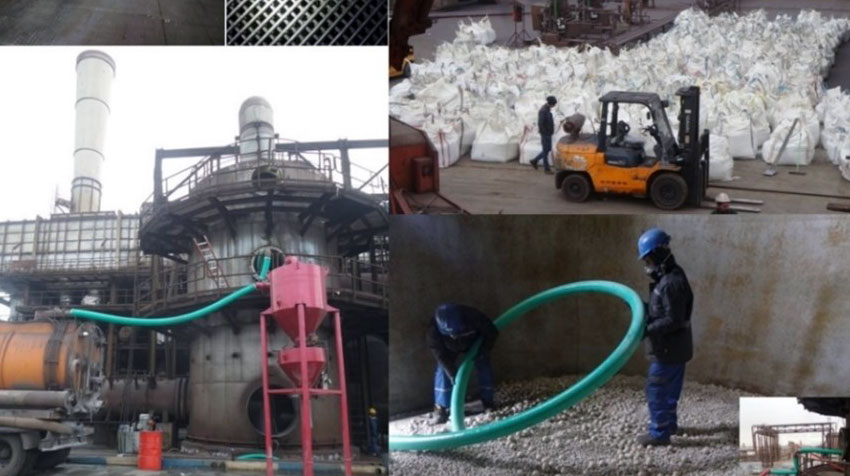
To determine the percentage of promoters such as copper and their impact on the adsorbent structure, Iran Catalyst has developed a comprehensive testing methodology, including standard and advanced tests such as XRD, ICP, and SCM, alongside performance monitoring of desulfurization adsorbent units in petrochemical, oil refining, and steel industries.
Supported by its research center and laboratory at the Faculty of Chemical and Petroleum Engineering at Sharif University of Technology, Iran Catalyst can provide solutions for companies using desulfurization adsorbents in this field.
One of the key factors in improving the performance of desulfurization adsorbents (particularly for desulfurization) and extending their lifespan is the precise control of active metal content, especially copper nanoparticles (Cu), in the adsorbent structure. The weight percentage of copper and its distribution can directly affect the adsorption capacity, thermal stability, and mechanical strength of the adsorbents. Therefore, Iran Catalyst has developed and implemented a comprehensive evaluation methodology, offering an integrated approach to structural and performance analysis of adsorbents that is not only accurate in laboratory settings but also fully aligned with field monitoring data from petrochemical, refinery, and steel units.
This methodology includes a set of standard and advanced tests, each addressing specific aspects of the adsorbent’s behavior:
Testing and Monitoring Methods
- XRD (X-Ray Diffraction) Using XRD, the crystalline phases present in the adsorbent and the distribution of copper in the crystalline structure can be identified. This test helps determine whether copper is uniformly distributed or aggregated in certain areas, which directly impacts sulfur adsorption performance and efficiency.
- ICP-OES / ICP-MS (Inductively Coupled Plasma) Determination of precise metal content (e.g., Cu, Ni, Co, Rh).
- SCM (Surface & Chemical Mapping) SCM enables the observation of copper distribution on the surface and within the pores of the adsorbent. This method reveals whether copper is properly positioned in active sites or has an uneven distribution, which could reduce adsorption efficiency.
- Field Performance Monitoring In addition to laboratory tests, the actual performance of adsorbents in industrial units is monitored. Data collected from petrochemical, refinery, and steel industries serve as a reference for comparison with laboratory results, ultimately providing a precise picture of the adsorbent’s efficiency. This field monitoring is a key strength of Iran Catalyst’s methodology, ensuring that results are not only theoretical but also reliable in practical applications.
Advantages of Iran Catalyst’s Services in the Field of Desulfurization Adsorbents
- Reduced operational costs through the selection of optimal adsorbents and extended lifespan.
- Assurance of adsorbent quality and stability through comprehensive and combined testing.
- Provision of accurate and reliable analytical reports for strategic decision-making.
- Continuous specialized support by Iran Catalyst’s technical team across various industries.