
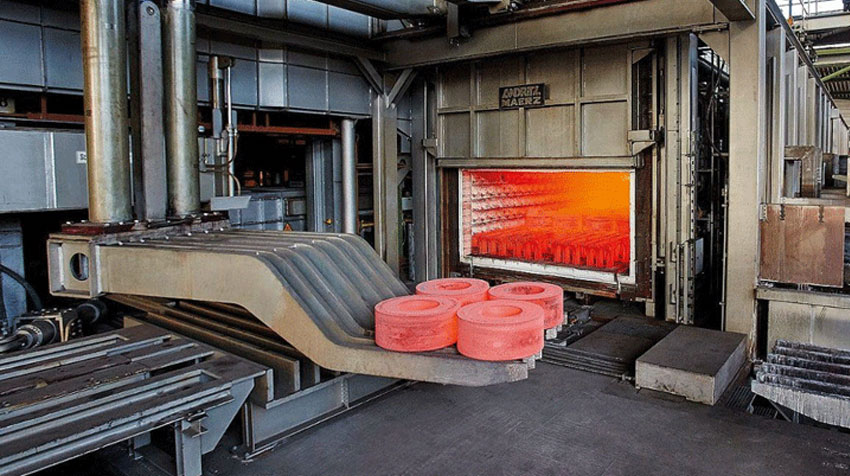
In the metal and automotive industries, heat treatment processes play a key role in hardening, carburizing, and nitrocarburizing steel. To perform these processes, endothermic gas is used as a controlled atmosphere. The production of this gas requires endothermic gas synthesis catalysts, which facilitate the decomposition reactions of natural gas and air. Major companies such as Tabriz Tractor Manufacturing, Chakheshgar, Haft Almas Qazvin, and others use these catalysts for their heat treatment lines. In Iran, Iran Catalyst is recognized as the technical reference and provider of engineering services and production for these catalysts.
In August 2025, Iran Catalyst had the honor of collaborating with Tabriz Tractor Manufacturing Company to provide technical and engineering services in the field of endothermic synthesis catalysts.
Role of Catalysts in Endothermic Gas Production
Heat treatment furnaces for processes like carburizing, nitrocarburizing, and protective annealing use controlled atmospheres to regulate the mechanical properties of steel. Endothermic gas is one of the most common atmospheres, produced through the partial reaction of natural gas (methane) with air. This reaction is endothermic (heat-absorbing) and has very low efficiency without the presence of a catalyst.
Mechanism of Endothermic Gas Production
The output gas primarily consists of CO, H₂, and N₂, with an approximate ratio of 20:40:40, depending on the design and conditions. A nickel-based catalyst on an alumina support reduces the activation energy of this reaction and ensures the stability of the gas composition.
- Endothermic Gas Production: Generated from the reaction of methane (CH₄) with air at high temperatures (900–۱۰۰۰°C). This reaction is endothermic and requires a catalyst for adequate speed and efficiency.
- Final Gas Composition: Nitrogen (N₂), carbon monoxide (CO), and hydrogen (H₂)
- Catalyst Used: Nickel alloy on an alumina or refractory ceramic base
- Catalyst Function: Reduces the reaction’s activation energy and stabilizes the quality of the output gas
Structure and Materials of Endothermic Catalysts
- Active Metal: Nickel (Ni) – occasionally cobalt or nickel-copper alloys
- Support: Alumina (Al₂O₃) or high-surface-area refractory ceramics
- Physical Form: Rings, spheres, or saddles to maximize gas contact surface
- Key Properties: Thermal resistance (up to 1100°C), mechanical stability, resistance to carbonization and sulfation
Importance of Dew Point Control in Heat Treatment
The dew point is the primary indicator for assessing moisture and carbon potential in endothermic gas.
- Low Dew Point: Drier environment, stronger carburization, suitable for deep hardening
- High Dew Point: Higher moisture, potential for decarburization and surface oxidation
- Dew Point Control: Ensures the quality of the hardened layer and prevents surface defects. Advanced systems monitor the dew point online and maintain stable catalyst performance.
Dew Point as a Key Indicator of Moisture and Carbon Potential:
- Low Dew Point (Dry Gas):
- Increases carbon potential → greater carbon penetration into the steel surface
- Suitable for deep carburization, but risks surface burning
- High Dew Point (Wet Gas):
- Reduces carbon potential → potential for decarburization or surface oxidation
- Unsuitable for precise hardening
- Dew Point Control: Typically maintained in the range of -20 to +20°C. Small changes in this parameter can directly affect the hardness and surface quality of components.
Carbonitriding
Carbonitriding is a surface hardening process in which both nitrogen and carbon are absorbed into the surface, with the absorbed nitrogen enhancing the hardness of the carburized surface. The temperature range for carbonitriding is 800–۸۷۵°C.
Advantages of Using Endothermic Catalysts
- Reduced energy consumption in endothermic gas generators
- Stable gas quality and uniformity in heat treatment processes
- Longer furnace and equipment lifespan due to precise moisture and temperature control
- Continuous and cost-effective production for automotive and steel production lines
Catalyst Monitoring and Maintenance
- Degradation Factors: Carbon deposition, sulfation, silicate contamination
- Regeneration Method: Thermal washing or periodic replacement after performance decline
- Performance Indicators: Output gas composition (CO/H₂), dew point, gas production rate
Applications in Iranian Industries
Major industrial companies use this technology for carburizing gears, crankshafts, and steel sheets.
- Tabriz Tractor Manufacturing: Hardening of power transmission components and chassis
- Haft Almas Qazvin: Production of high-surface-hardness steel sheets for automotive industries
What is the Difference Between Annealing and Endothermic Hardening?
- Annealing: Aims to soften the metal, reduce internal stresses, and improve formability.
- Endothermic Hardening: Aims to increase surface hardness and wear resistance.
- In annealing, a neutral or slightly reducing atmosphere (e.g., nitrogen or hydrogen) is typically used to prevent oxidation, whereas in endothermic carburizing, the gas must have a high carbon potential.
Is Endothermic Gas Used in Annealing?
Yes, in some protective annealing lines, endothermic gas is used because the CO and H₂ composition creates a relatively neutral and clean environment, preventing surface corrosion. However, in annealing, the goal is not carbon injection but rather preventing oxidation and controlling the dew point to keep the component surface clean.
Role of Dew Point and Catalyst in Annealing
- The endothermic catalyst, used in hardening, is also employed to produce gas for annealing.
- Dew point control in annealing is critical because high dew points can cause moisture-induced surface oxidation, reducing the final quality.
- In precise annealing, the dew point must be even lower than in hardening to ensure a completely clean surface.
Iran Catalyst Services in the Field of Endothermic Gas Synthesis
Companies active in heat treatment and metal hardening industries, including major automotive and steelmaking complexes, require specialized catalysts for the production and control of endothermic gas. These catalysts play a vital role in the quality of hardening, dew point control, and enhancing production line efficiency. In Iran, Iran Catalyst, as the specialized reference in this field, provides comprehensive engineering services and is ready to collaborate with industrial units to optimize heat treatment processes and improve final product quality. In August 2025, Iran Catalyst had the honor of collaborating with Tabriz Tractor Manufacturing Company to provide technical and engineering services in the field of endothermic synthesis catalysts.